Neural Material Adapter: Transforming Complex Materials into Efficient Analytic BSDFs
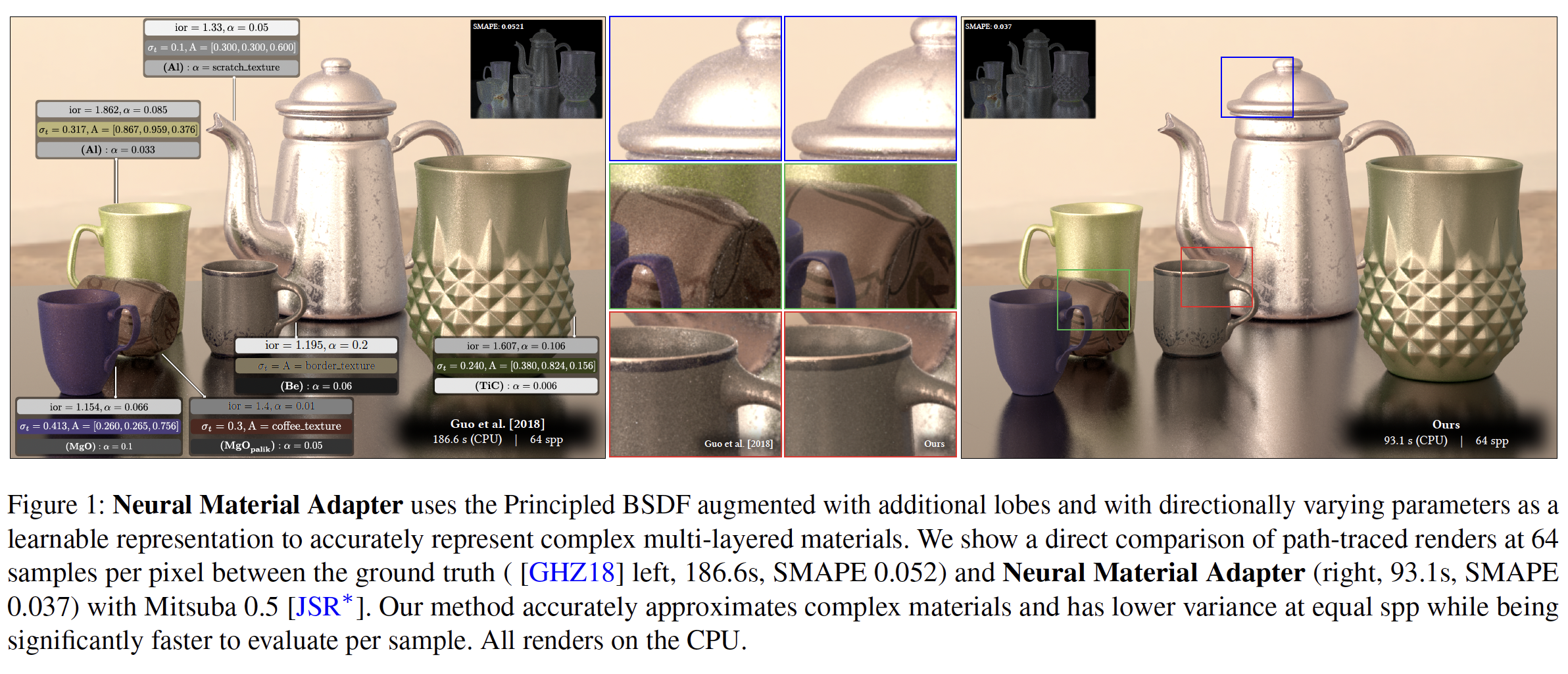
In this work, we present the Neural Material Adapter (NMA), a framework
that bridges the gap between high-fidelity material data and efficient rendering by mapping complex appearances into the parameter space of differentiable analytic BRDFs.
Authors
Rajesh Sharma (ETH Zurich/DisneyResearch|Studios)
Tiziano Portenier (DisneyResearch|Studios)
Sebastian Weiss (DisneyResearch|Studios)
Markus Gross (DisneyResearch|Studios/ETH Zurich)
Marios Papas (DisneyResearch|Studios)
Neural Material Adapter: Transforming Complex Materials into Efficient Analytic BSDFs
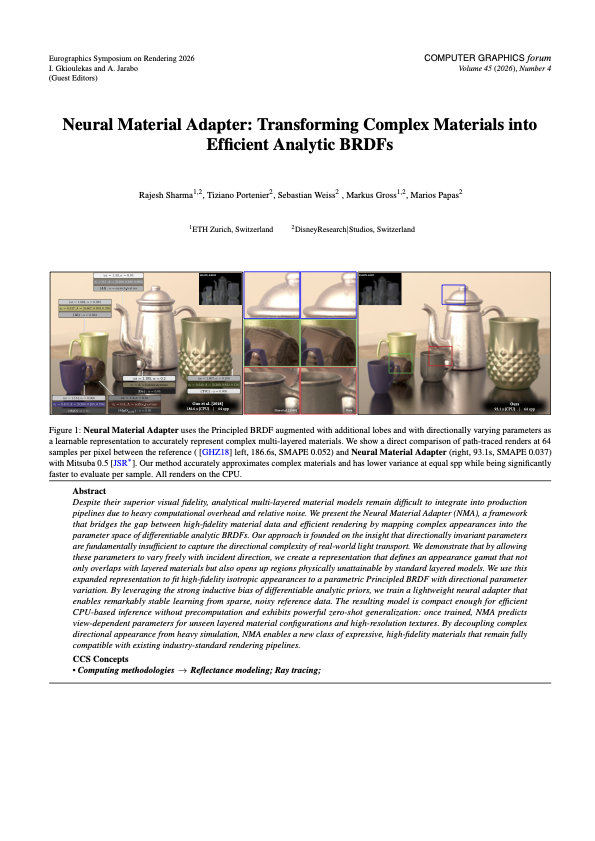
Despite their superior visual fidelity, analytical multi-layered material models remain difficult to integrate into production pipelines due to heavy computational overhead and relative noise. We present the Neural Material Adapter (NMA), a framework that bridges the gap between high-fidelity material data and efficient rendering by mapping complex appearances into the parameter space of differentiable analytic BRDFs. Our approach is founded on the insight that directionally invariant parameters are fundamentally insufficient to capture the directional complexity of real-world light transport. We demonstrate that by allowing these parameters to vary freely with incident direction, we create a representation that defines an appearance gamut that not only overlaps with layered materials but also opens up regions physically unattainable by standard layered models. We use this expanded representation to fit high-fidelity isotropic appearances to a parametric Principled BRDF with directional parameter variation. By leveraging the strong inductive bias of differentiable analytic priors, we train a lightweight neural adapter that enables remarkably stable learning from sparse, noisy reference data. The resulting model is compact enough for efficient CPU-based inference without precomputation and exhibits powerful zero-shot generalization: once trained, NMA predicts view-dependent parameters for unseen layered material configurations and high-resolution textures. By decoupling complex directional appearance from heavy simulation, NMA enables a new class of expressive, high-fidelity materials that remain fully compatible with existing industry-standard rendering pipelines.