IBMM++: Improved and versatile motion generation with implicit Bézier curves
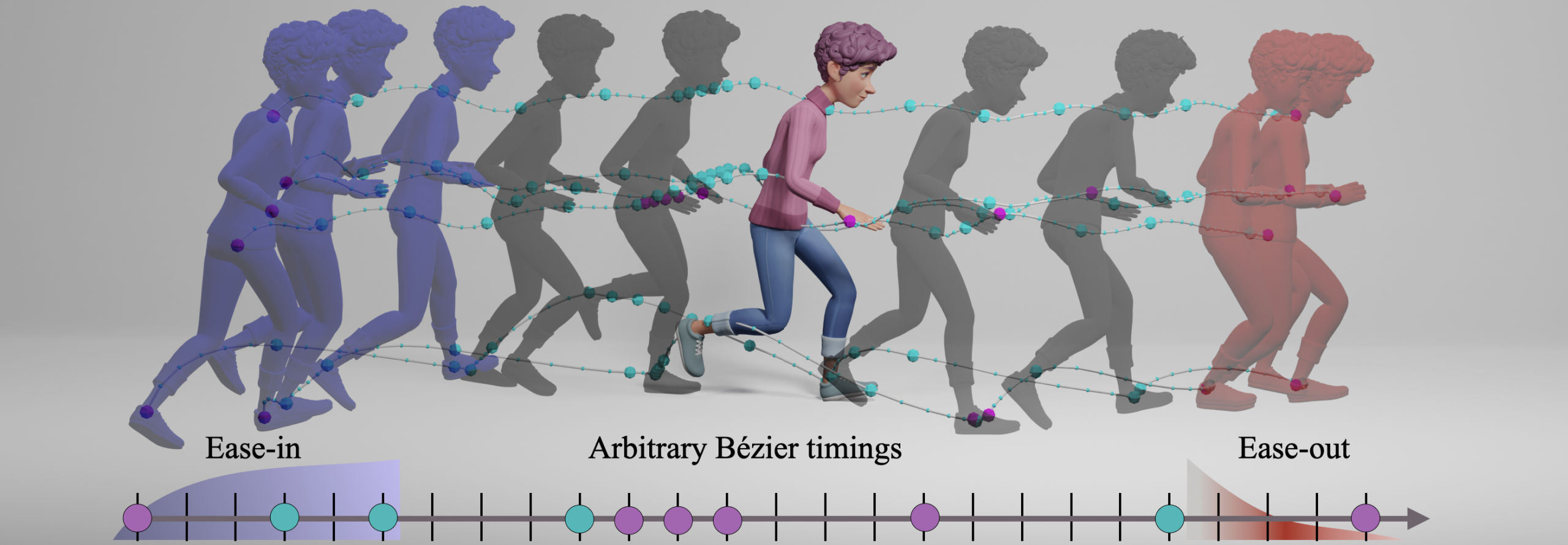
In this work, we introduce extended version (IBMM++), we further improve constraint accuracy, reduce foot sliding, and enable motion extension, orientation constraints, longer sequences, and stable iterative editing through architectural updates, a revised tangent formulation, a randomized constraint sampling strategy, and dedicated inference-time methods, validated on a larger internal dataset with more varied motions.
Authors
Dhruv Agrawal (DisneyResearch|Studios/ETH Zurich)
Luca Vögeli (DisneyResearch|Studios)
Dominik Borer (DisneyResearch|Studios)
Robert W. Sumner (DisneyResearch|Studios/ETH Zurich)
Martin Guay (DisneyResearch|Studios)
Jakob Buhmann (DisneyResearch|Studios)
IBMM++: Improved and versatile motion generation with implicit Bézier curves
Creating high-quality character animation remains an intricate and cumbersome process. Recently, diffusion models have unlocked the ability to generate diverse movements from high-level condition signals such as text. For artist-friendly control, motion diffusion leveraging Bézier curves have been shown to allow precise joint-level conditioning. Yet, these works have been limited to joints at a fixed temporal stride, while animators require more temporal flexibility when keyframing or manipulating tangents to achieve animation principles such as easing in & out. In Vögeli et al. we presented a new Implicit Bézier Motion Model (IBMM), which during training is exposed to all possible configurations of control points, enabling control at arbitrary timings. In addition, we introduced a new quantitative measure of ease-in and-out, which leads to a novel condition over the motion generation process to reflect this artistic principle. In this extended version (IBMM++), we further improve constraint accuracy, reduce foot sliding, and enable motion extension, orientation constraints, longer sequences, and stable iterative editing through architectural updates, a revised tangent formulation, a randomized constraint sampling strategy, and dedicated inference-time methods, validated on a larger internal dataset with more varied motions.