Illumination-Aware Spatial Subdivision for Path Guiding
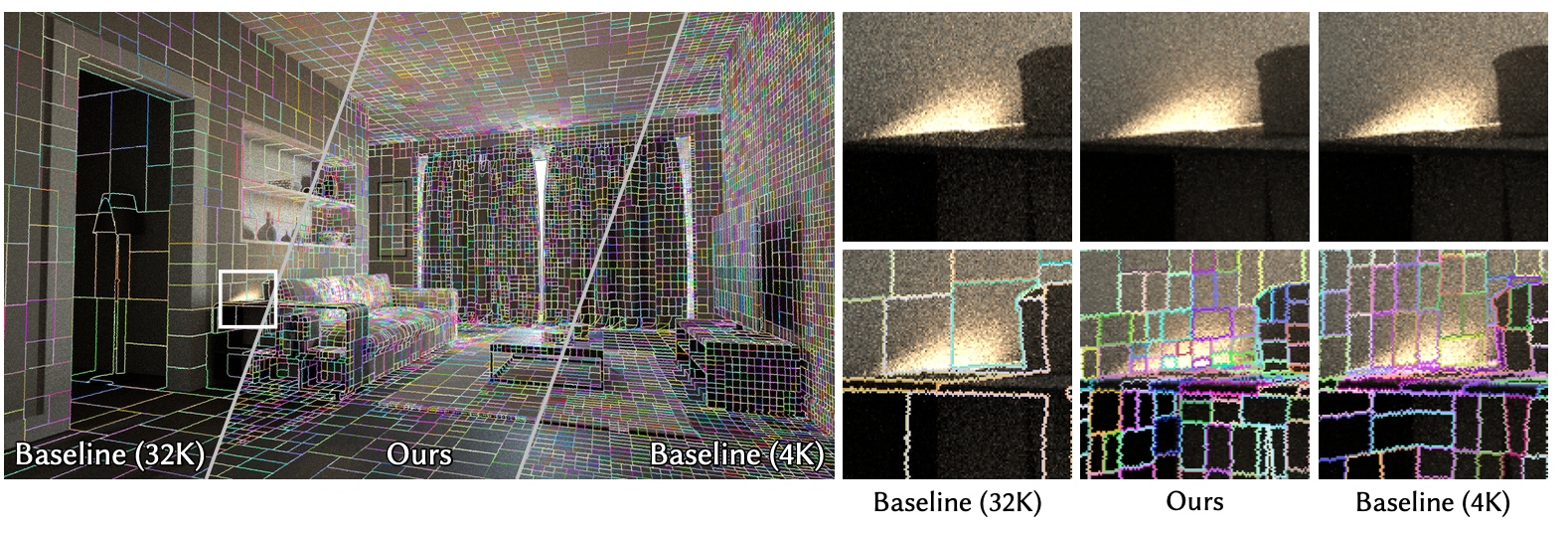
In this work, we propose a method to adapt the k-d tree depending on the variation in the illumination. To this end, we use lookahead cells, i.e. multiple additional levels of k-d tree cells that do not store a guiding distribution.
Authors
Fengshi Zheng (Delft University of Technology)
Christoph Peters (Delft University of Technology)
Sebastian Herholz (Blender Institute)
Marco Manzi (DisneyResearch|Studios)
Elmar Eisemann (Delft University of Technology)
Illumination-Aware Spatial Subdivision for Path Guiding
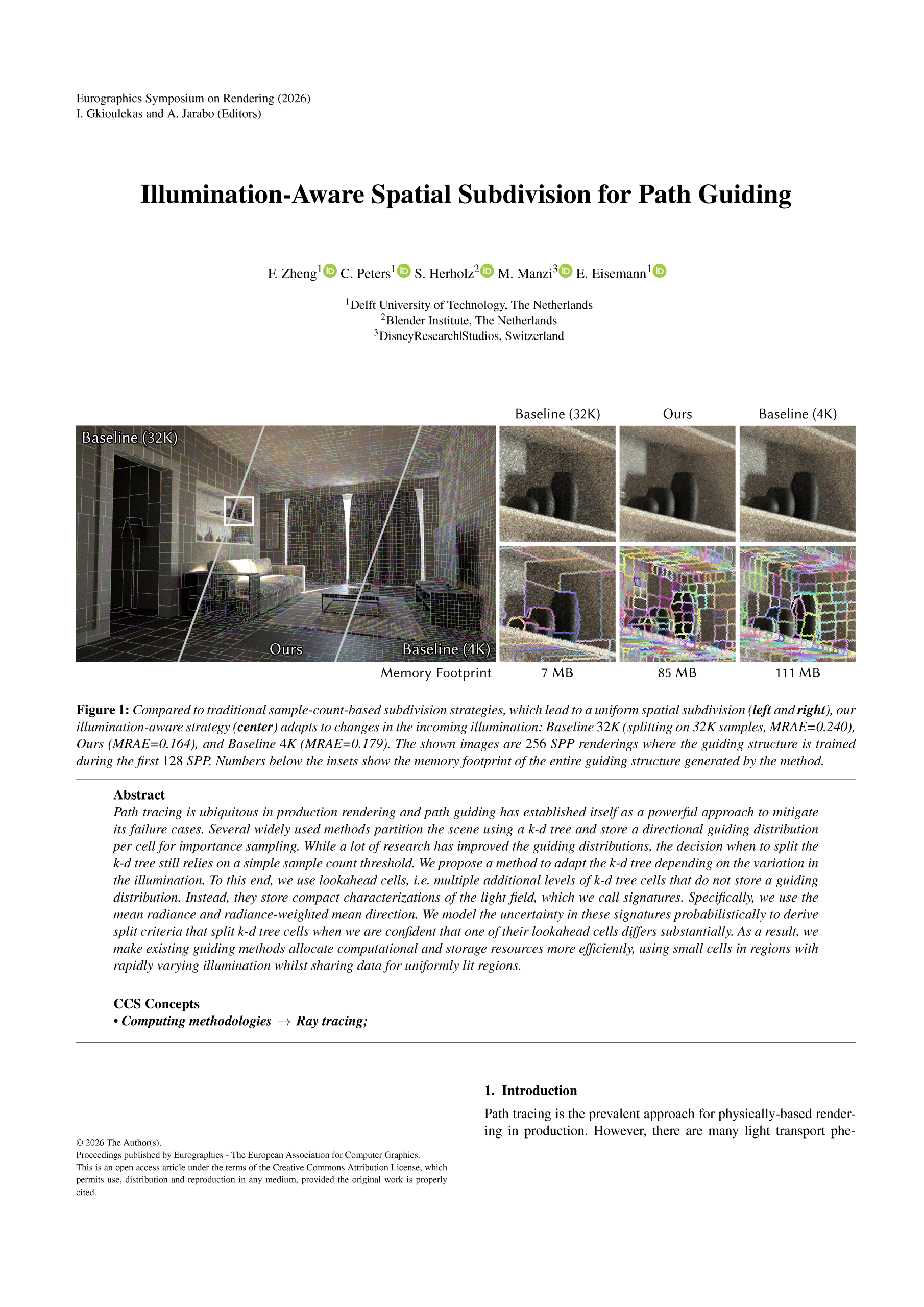
Path tracing is ubiquitous in production rendering and path guiding has established itself as a powerful approach to mitigate its failure cases. Several widely used methods partition the scene using a k-d tree and store a directional guiding distribution per cell for importance sampling. While a lot of research has improved the guiding distributions, the decision when to split the k-d tree still relies on a simple sample count threshold. We propose a method to adapt the k-d tree depending on the variation in the illumination. To this end, we use lookahead cells, i.e. multiple additional levels of k-d tree cells that do not store a guiding distribution. Instead, they store compact characterizations of the light field, which we call signatures. Specifically, we use the mean radiance and radiance-weighted mean direction. We model the uncertainty in these signatures probabilistically to derive split criteria that split k-d tree cells when we are confident that one of their lookahead cells differs substantially. As a result, we make existing guiding methods allocate computational and storage resources more efficiently, using small cells in regions with rapidly varying illumination whilst sharing data for uniformly lit regions.